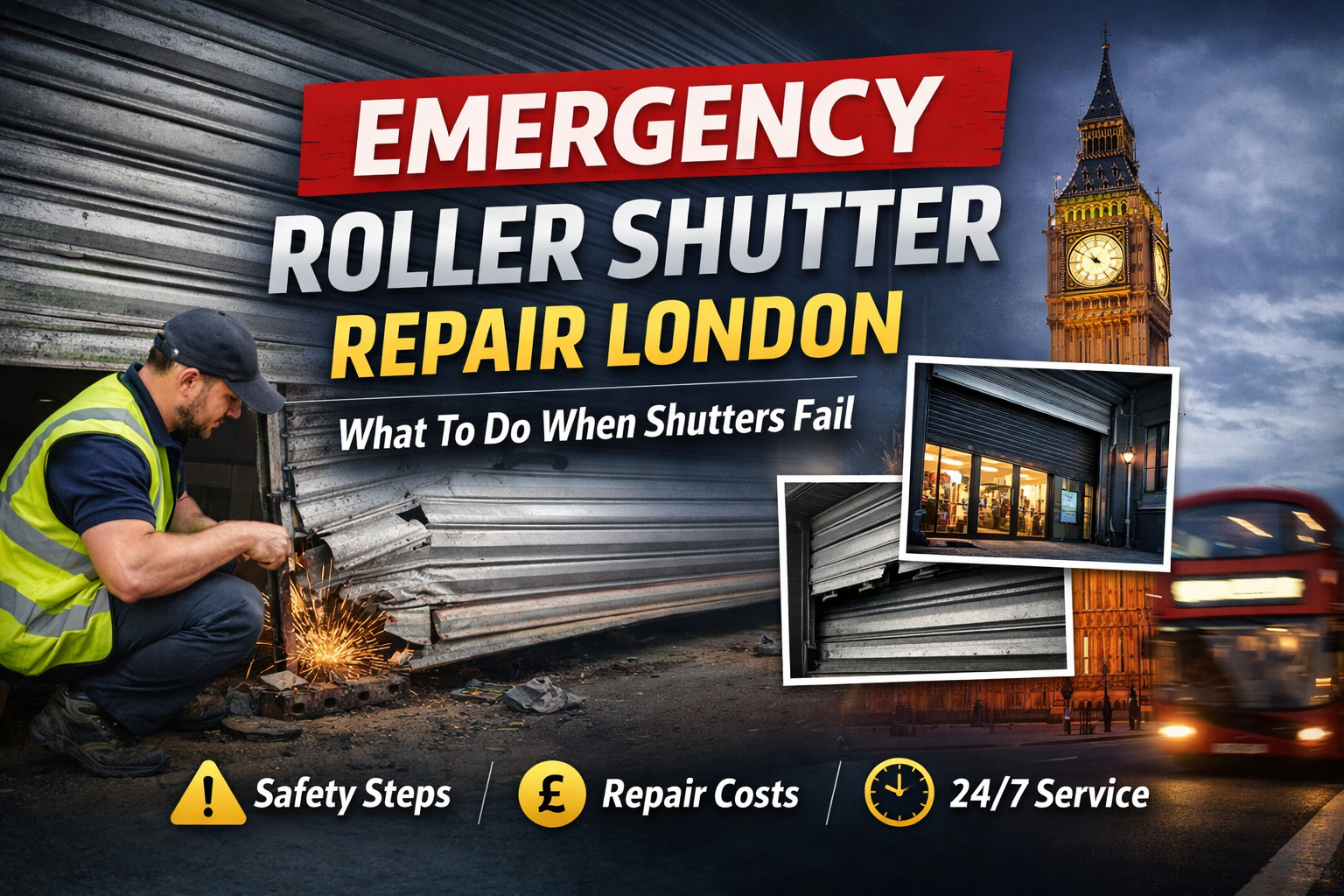
A roller shutter failure is rarely convenient. In London, it can also be risky: a stuck-open shopfront invites theft, a jammed shutter traps staff inside, and a damaged curtain can become a safety hazard on a busy pavement. The right response in the first 10 minutes can reduce damage, prevent injury, and lower repair costs.
This guide explains exactly what to do when a shutter fails, what usually causes the problem, what emergency repairs typically cost in London, and how to choose a reliable 24/7 repair company.
Key takeaways
- Stop operating the shutter immediately if it’s grinding, skewing, or stuck—forcing it often burns out the motor and bends guide rails.
- Isolate power for electric shutters before touching anything (switch isolator off or shut off the circuit at the consumer unit).
- Secure the premises fast if the shutter is stuck open: staff the entrance, move stock away from view, and consider temporary boarding.
- Don’t DIY spring, barrel, or motor repairs; these parts can cause serious injury and further damage.
- Emergency call-outs in London commonly vary by time and parts; simple resets are cheaper than motor or rail replacements.
When does a roller shutter problem become an emergency?
Not every fault needs an out-of-hours engineer, but these situations usually do:
- Shutter stuck open and your site is exposed (shopfront, warehouse, pharmacy, off-licence, takeaway, etc.).
- Shutter stuck closed and you cannot trade, access stock, or open safely.
- Shutter stuck halfway (often indicates a mechanical imbalance, obstruction, or motor/limit issue).
- Visible damage after impact, vandalism, or attempted break-in.
- Shutter off its guides, hanging at an angle, or scraping heavily.
- Electrical hazards such as burning smell, overheating motor, tripping breakers, or smoking control gear.
- Fire exit/access obstruction where the shutter blocks a required escape route or safe entrance.
First 10 minutes: what to do immediately
1) Stop using the shutter (don’t “try it again”)
If the shutter is struggling, making unusual noise, or moving unevenly, repeated attempts can escalate a minor fault into a major one. A motor that’s forced against resistance can fail completely, and a curtain pushed out of alignment can deform the guide rails.
2) Make the area safe
- Keep customers and staff away from the shutter opening and guide rails.
- Do not stand under a shutter that is stuck partly open.
- If the shutter is on a shopfront, consider controlling foot traffic near the entrance until you know it’s stable.
3) Isolate the power (electric shutters)
Turn off the shutter at the isolator switch (commonly near the shutter or control panel). If you can’t locate it, turn off the relevant circuit at the consumer unit. This prevents accidental activation and protects anyone inspecting the shutter.
4) Do only basic checks (no tools, no disassembly)
These checks may solve simple, non-mechanical issues:
- Power cut: check whether neighbouring units have power. If the building has a known outage, the shutter may be fine.
- Tripped breaker/fuse: if the circuit trips repeatedly, leave it off and call an engineer—this suggests a fault.
- Remote/key fob battery: replace batteries if the shutter is otherwise responsive.
- Key switch: confirm the key turns fully and returns properly; worn switches can prevent operation.
- Obstructions: check the bottom rail and guides for debris (packaging, stones, cable ties). Only remove what you can safely reach.
5) Secure your premises if the shutter is stuck open
If the shutter won’t close and your property is exposed:
- Move high-value items away from the front and out of sight lines.
- Keep one staff member at the entrance until help arrives (where safe and practical).
- Use temporary barriers inside the doorway to slow entry.
- Consider emergency boarding if you expect a delay or the area has high risk.
What not to do (to avoid higher costs and injuries)
- Do not force the shutter by hand without a proper manual override procedure.
- Do not open the shutter box or attempt spring/barrel repairs; stored tension can release violently.
- Do not spray random lubricants into the motor, control panel, or brakes. Incorrect lubrication can attract grit and worsen sticking.
- Do not bypass safety controls (edge sensors, photocells, limit settings). That creates liability and safety risk.
Common causes of emergency roller shutter failures in London
London sites see a mix of heavy daily use, tight loading areas, frequent deliveries, and accidental impacts. The most common failure points include:
1) Motor failure or overheating
Electric shutters can overheat from repeated cycles (common during busy trading hours). If the shutter is struggling due to friction or misalignment, the motor works harder and may burn out. Warning signs include buzzing, slow movement, intermittent stopping, or a burning smell.
2) Misaligned or damaged guide rails
An impact from a delivery trolley, vehicle, or forced entry attempt can bend a guide rail. Even small bends can cause the curtain to bind, scrape, or jump out, quickly turning into a jam or a shredded end lock.
3) Broken springs or barrel issues (manual or assisted systems)
Springs balance shutter weight. When they weaken or snap, the shutter becomes heavy, unsafe, and difficult to lift—even if it’s motorised. A shutter may drop suddenly or refuse to lift beyond a point.
4) Curtain damage, end locks, or slat failure
Damaged slats, loose end locks, or a distorted bottom rail can cause the curtain to “walk” sideways and jam. This often happens after attempted break-ins or when a shutter hits an obstruction while closing.
5) Control faults: key switch, receiver, wiring, or limit settings
Problems in the control system can make a shutter appear “dead” even when the motor is fine. Common issues include loose terminals, water ingress in external switches, faulty relays, or incorrectly set travel limits after previous repairs.
Can you close an electric shutter manually during a power cut?
Sometimes, yes—if the shutter has a proper manual override (handover chain, crank handle, or geared override). The safe approach is:
- Isolate power first.
- Follow the specific manufacturer procedure for the override system.
- Stop immediately if there is resistance, skewing, or scraping (that suggests a mechanical jam).
If you are unsure, wait for an engineer. Forcing a jammed shutter manually can bend the curtain, damage the barrel, and cause injury.
Who to call for emergency roller shutter repair in London
Choose a repair provider that can handle both security and safety—not just “get it moving.” When calling, look for:
- 24/7 availability with genuine out-of-hours response (not “next business day”).
- London coverage with mobile engineers who carry common parts (receivers, switches, locks, slats, end locks).
- Clear call-out pricing and a written quote for parts and labour before major work.
- Experience with your shutter type: manual, chain-operated, tubular motor, industrial, high-security, perforated/punched, fire-rated.
- Proof of insurance and professional workmanship (important for commercial landlords and insurers).
Information to give the engineer (speeds up arrival and diagnosis)
- Your exact London postcode and parking/loading access details.
- Whether the shutter is stuck open, closed, or halfway.
- If it’s manual or electric and what controls it uses (remote, key switch, push button).
- Any noises/smells (grinding, loud bang, burning smell).
- Photos or a short video showing the shutter alignment and the guide rails.
- Whether there was an impact or break-in attempt.
Emergency roller shutter repair costs in London (typical ranges)
Emergency costs vary based on timing, shutter size, access, and whether parts are needed. Below are realistic ballpark ranges you can use for planning and comparison. Exact prices depend on your shutter type and the fault.
Typical cost components
- Call-out / attendance: higher at night, weekends, and bank holidays.
- Labour time: simple resets are quicker; rail alignment and curtain repairs take longer.
- Parts: motors, slats, end locks, switches, and control boards can change the cost significantly.
- Making safe vs full repair: sometimes a same-night “secure and safe” solution is possible, with a scheduled return for full replacement parts.
Indicative London pricing (guide only)
- Standard daytime call-out: often from £120–£180 (depending on area and provider).
- Evenings/weekends emergencies: commonly £180–£300+.
- Minor electrical fix (switch/receiver/fuse diagnosis): often £150–£350 total if parts are simple.
- Guide rail realignment/repair: often £200–£600 depending on damage.
- Motor replacement: commonly £300–£900+ depending on shutter size/spec and access.
- Slat/curtain repair: varies widely; small repairs may be £200–£500, while larger curtains can be substantially more.
Tip: Ask whether the quote includes VAT, congestion-related travel considerations, and any parking requirements. Transparent providers will confirm this upfront.
Temporary “make safe” vs permanent repair: what’s the difference?
During late-night emergencies, the priority is often to secure the premises. That may require a temporary solution first, followed by a permanent fix when parts are sourced.
Temporary make-safe (common examples)
- Re-seating the curtain into guides if it has jumped out (only if undamaged).
- Isolating a faulty control component to prevent movement until repaired.
- Fitting temporary locks or securing the shutter in the closed position.
- Boarding a shopfront if the shutter cannot be closed safely.
Permanent repair (what you should expect)
- Root-cause correction: alignment, worn parts replacement, proper limit setting.
- Safety checks and smooth operation test (up/down cycles).
- Replacement parts appropriately matched to shutter rating and usage.
- Documentation/invoice suitable for landlord or insurance records.
How long do emergency shutter repairs take?
Many emergency call-outs can be resolved on the first visit, especially if the issue is a jam, misalignment, or minor electrical fault. However, repairs take longer when:
- The curtain is badly bent or several slats must be replaced.
- The motor has failed and a like-for-like replacement must be sourced.
- The shutter has suffered break-in damage affecting rails, barrel, and locks.
- Access requires special equipment (large industrial shutters, high-level works).
A reputable engineer will tell you quickly whether they can fix it immediately or if they need to make safe and return with parts.
Preventing future roller shutter emergencies
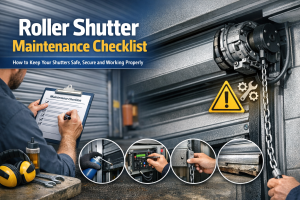
Most emergency failures start as small issues: a slight scrape, occasional sticking, or a shutter that needs “help” to close. A basic maintenance routine reduces breakdown risk and improves security.
Practical prevention checklist
- Listen for changes: new grinding, louder operation, or uneven movement usually signals misalignment or wear.
- Keep guides clean: grit and debris in the rails increases friction and strains motors.
- Use the shutter correctly: avoid rapid repeated cycling and don’t close onto obstructions.
- Schedule servicing: periodic inspection of curtain, end locks, barrel, fixings, and electrics catches issues early.
- Address small damage immediately: a minor dented slat can lead to repeated jams and bigger curtain damage.
FAQ
Why is my shutter stuck halfway open?
Common causes include guide rail misalignment, an obstruction, damaged slats/end locks, broken springs, motor/limit setting issues, or power/control faults. A shutter stuck halfway should be treated as unsafe until inspected.
Is it safe to keep trying the button/remote?
No. Repeated attempts can overheat the motor, damage the curtain, or pull the shutter further out of alignment. Stop and assess basic power/remote checks only.
Should I repair or replace my roller shutter?
Repair is usually cost-effective when the structure is sound and parts are available. Replacement may be smarter if the shutter has repeated failures, significant curtain deformation, obsolete controls, or extensive break-in damage.
Will an emergency repair come with a warranty?
Many professional companies provide a warranty on parts and workmanship, but terms vary. Always ask for confirmation in writing and keep your invoice for records.
Summary: the safest, fastest response
If your roller shutter fails in London, the priority is simple: stop operating it, isolate power, keep people away, and secure the premises. Then call a qualified emergenacy shutter repair specialist who can diagnose the root cause and restore safe operation without cutting corners.
When you handle the first steps correctly, you reduce the chance of motor burnout, curtain damage, and costly repeat failures—while keeping your property protected and your business running.